Book Finds and Good Reads

Travel • Culture • Stories

Friday, February 6, 2026

The Silent Patient - Alex Michaelides


With suspense novels, it is a stretch to expect the level of prose and narrative pull found in Dennis Lehane’s Mystic River, or, more precisely, in psychological suspense like Gillian Flynn’s Gone Girl and a select few other masterful writers in the genre.


Wednesday, January 21, 2026

The Ten Year Affair – Erin Somers


Literature and cinema have long framed infidelity as the realm of complex people, those seduced by ambition, power, or erotic excess, fleeing from spouses appearing dull by comparison or committing abuse. Erin Somers’s The Ten Year Affair resists that over used theme. Its protagonists are noticeable for their ordinariness. Like the ordinary characters played by Robert De Niro and Meryl Streep in the classic film “Falling in Love”, a story of two random commuters who always meet on the train, the book’s leading characters Cora and Sam are neighbors who are as any other normal homeowners.


Cora is a mother of two, stalled in a job beneath her capacities, married to Eliot, a man full of dreams and emotionally generous husband whose very chill demeanor invites room for deceit. Sam, married to the driven and career woman Jules, is similarly unremarkable. Their affair is not born of grand passion but of domestic fatigue: the dull ache of routines perfected inside the household and the schools of their children and personal desires and dreams put to the side.


The Ten Year Affair follows our millennial foursome characters (Sam and Eliot celebrated their 40th birthdays sometime after the pandemic) through their friendship, closeness to each other in a country town a couple of hours away from New York City, and years of unspoken longing.


The novel takes us on a journey as Cora and Sam, drawn together through shared domestic tasks of mostly working from home and being active parents in the children’s school lives, beginning a relationship that blossoms slowly in real life and fast-paced in the imaginary world. As time passes, parallel versions of their lives - one imagined, one real - begin to combine, forcing choices that test loyalty, responsibility, and the cost of desire acted upon.


Somers introduces a “sliding doors” structure early through the novel, contrasting fantasy and actuality. When the imagined life proves more complicated than the real one because of the affair, the book takes a turn as the real world becomes where the true infidelity happens. The affair’s emotional consequences, particularly for Cora, are rendered with restraint rather than melodrama. Sam’s moral stonewalling, meanwhile, is as infuriating as it gets. His instinct to preserve his marriage while abandoning Cora's own dilemma in being the other half of the affair,  leaves the reader feeling that he ultimately earns the ending he receives.


Claims that the novel rivals Madame Bovary as one of the best book about having an affair is a stretch of the imagination. Still, Somers delivers something direct and perhaps equally unsettling: a study of marriage not as romance gone sour, but as endurance tested by exhaustion, parenthood, economic pressure and the temptation to believe that life might feel fuller with someone else, even within an otherwise non-toxic marriage.


If you’re not in a toxic relationship, I guess, then don’t play games, as the novel would want to convey.


★★½ 

Friday, January 9, 2026

A Guardian and a Thief - Megha Majumdar


I have always gravitated toward Asian literature, drawn to its focus to interior lives and its ability to connect the personal with the political. That pull becomes even stronger when the setting is India, a place I’ve visited four times in the past and where history, inequality, and survival often appears more powerful on the page. Megha Majumdar’s A Guardian and a Thief arrives squarely within that scope, offering a speculative yet unsettlingly portrait of a near-future Kolkata reshaped by climate catastrophe and moral compromise.


Tuesday, January 6, 2026

Before the Coffee Gets Cold (Toshikazu Kawaguchi)


Reading Toshikazu Kawaguchi’s Before the Coffee Gets Cold reminded me of those early days of discovering Haruki Murakami when Japanese fiction first revealed its different style for building atmosphere rather than relying on surprising plot-twists. Like Murakami, Kawaguchi crafts a world where the characters exists alongside the mundane, where emotional truth matters more than logic, and where the real journey is found on each character's realization.


Where Murakami leans toward surrealism, existential drift, and metaphysical loneliness, Kawaguchi threads the simpler ground. He creates a world that is smaller, almost domestic – in the case for this book. The café replaces the dreamscape; regret replaces alienation. Both writers, however, share a focus for mood, memory, and the unspoken weight of human relationships.

Set in a small Tokyo café rumored to offer a chance to travel through time, Before the Coffee Gets Cold explores what happens when people are briefly allowed to revisit moments they wish they could change. Bound by a strict set of rules and the certainty of returning to the present, visitors must confront any regret and unfinished emotions. What unfolds is not a science fiction story about time travel itself, but about what it means to be human within it.

At the heart of the novel are its characters: ordinary people portrayed for readers to easily relate to, Fumiko, career-driven yet vulnerable woman longing for closure with his ex-boyfriend Goro. Kotake, a caring nurse who carries a lifetime of unspoken devotion to her Alzheimer stricken husband Fusagi. (Yaeko) Hirai, a café regular with a rebellious streak but has a soft spot for her younger sister (Kumi). The cafe owners Nagare and Kei whose own storyline tugs at the heartstrings, especially bout Kei's reason for traveling through time.

And Kazu, the café’s steady presence, offers calm authority without ever overshadowing the stories going on around her. Each character feels less like a narrative device and more like someone you might have once known or been.

What makes these characters easy to relate to is not about their transformation, but their acceptance. Kawaguchi doesn’t force dramatic reversals. Instead, he allows small emotional shifts to do the heavy lifting: a change in perspective, a softened resentment, a moment of understanding that arrives too late and, somehow, just in time.

This is also what distinguishes Kawaguchi’s take on time travel. Reading Before the Coffee Gets Cold changed my own long-held view of the genre. I once thought of time travel as a fantasy of revising the past, therefore risking the present, or a gamble on a better outcome. Kawaguchi reframes it more elegantly: time travel here is not about changing what happened, but about changing how we carry on forward. The past remains intact; the present undisturbed. What alters is the future shaped by clarity rather than regret.

The novel is the first in a trilogy, and its structure reflects that larger arc. Each story stands alone yet contributes to a broader reflection on memory, choice, and emotional inheritance. There’s a confidence in how Kawaguchi trusts readers to read with uncertainty, to find significance without explanation.

I’m glad I discovered this book last year, even more so that I found the time to read it now. As the one that kickstarted my one-book-per-week resolution for 2026, it feels almost ceremonial like a reminder that some stories arrive exactly when they’re meant to.

Like a cup of coffee that must be finished before it cools, this novel asks only one thing of its reader: presence. And in return, it offers something rare; comfort without sentimentality, magic without escape, and a blend of feelings that stays long after the last page.


Rating: ★★★

Thursday, September 25, 2025

Manila International Book Fair Finds


I only managed to score two books at the Manila International Book Fair because of the thick crowd. Imagine last week’s Travel Fair, then multiply that by three or four.

That’s a great thing, though, since it shows that book reading is still very much alive, especially among Gen Zs.

Here's a bit about what I bought. 

According to its introduction, "Luzon and Mindanao" was first published in 1870, and written by Duc d’Alençon, a French traveler who was commissioned as an artillery man in the Spanish army.

Saturday, September 25, 2021

Asian Literature Purchase from Big Bad Wolf Books

Finally, I received the books I ordered from Big Bad Wolf Books last March. 

It's all Asian lit: 

- Silence by Shūsaka Endō

- Ticket to India by N.H. Senzai

- The Windfall by Diksha Basu

- Selection Day by Aravind Adiga

- Miss Burma by Charmaine Craig


Sophie Gianan collects her books from Big Bad Wolf books


Saturday, September 11, 2021

20 Books on the Marcos Dictatorship

“Those who cannot remember the past are condemned to repeat it.” - George Santayana 

But sadly, these books are not easily accessible nor available to most Filipinos today. 

What are easily available to them are TikTok and Facebook history revisionism content. 

Plus, our education system has faltered in promoting reading literacy and comprehension that most people today are easily swayed by fake narratives flooding the most accessible medium -- social media.


Pika Yonzon reads a book about the Marcos Dictatorship


Saturday, June 5, 2021

Booksale Finds of the Week

 Booksale haul. All for only 125 pesos. 

I swear, Booksale has gifted me with way better and interesting reads than NB and Fullybooked combined.

- The Speech of Angels by Sharon Mass (and because I'm a sucker for stories set in India)

Jomie Naynes reads the book the speech of angels

Thursday, August 10, 2017

In Cold Blood - Truman Capote


It was a chance encounter with a long-coveted title—Truman Capote’s In Cold Blood—that led me to Fully Booked at Gateway Mall. There, among the fiction and nonfiction, was Capote’s so-called “nonfiction novel,” a genre-defining work that continues to cast a long, chilling shadow over American letters.

Friday, July 7, 2017

Dance Dance Dance - Haruki Murakami

Haruki Murakami’s 1988 novel Dance Dance Dance, was my very first foray into his peculiar world (on the recommendation of my former and late officemate named Fae), turned out to be a strange, fascinating initiation.


Saturday, July 1, 2017

Lunar Park - Bret Easton Ellis


In Lunar Park, Bret Easton Ellis turns the scalpel inward, dissecting not only his persona but the legacy of his fiction. The novel opens with the style of an autobiography, recounting his meteoric rise to literary stardom at the age of 23, following the publication of Less Than Zero. Hollywood came calling (the novel was adapted into a film starring Robert Downey Jr.), and Ellis was soon anointed a literary figurehead of the so-called Brat Pack, chronicler of the hollow glamour and nihilistic indulgence that marked the Reagan era. With American Psycho and Glamorama, he established a signature style drenched in sex, drugs, and a nihilism sharpened into satire.

Friday, June 9, 2017

The Dharma Bums - Jack Kerouac


If On the Road was Jack Kerouac’s ecstatic hymn to youth, movement, and rebellion, then The Dharma Bums is its quieter, more contemplative sibling. Published in 1958, just a year after On the Road transformed Kerouac into a reluctant icon, The Dharma Bums trades the open highway for the high trails, the jazz-inflected chaos of cities for the peace of mountaintops.


Friday, October 7, 2016

Neverwhere - Neil Gaiman

 A magical, wicked story about Richard Mayhew, whose life is forever changed after he helps a bleeding girl on a London sidewalk. That single act pulls him into a reality far different from the world he thought he knew. Once again, Neil Gaiman vividly conjures a “world within a world” setting—strange, shadowy, and brimming with imagination.

“The Marquis scratched the side of his nose. ‘Young man,’ he said, ‘understand this: there are two Londons. There’s London Above—that’s where you lived. And there’s London Below—the underside—inhabited by people who fell through the cracks in the world. Now you’re one of them.’” —Neverwhere

Leaving behind the familiar streets of London Above, Richard embarks on a strange journey through London Below, meeting a colorful and unforgettable cast: the mysterious girl named Door; the enigmatic Marquis de Carabas; Hunter, a fierce bodyguard with a legendary reputation; talking rats; and a hilariously unhinged yet bloodthirsty pair of villains—Mr. Croup and Mr. Vandemar.

Through secret passageways, nonexistent (in London Above) subway stations, a floating market, hidden doors, questionable angels, cloistered friars, foul sewer systems, monstrous beasts, and places governed by bizarre physics, Neverwhere takes readers on a wildly imaginative, uplifting, and thrill-packed ride.

Think Harry Potter meets Alice in Wonderland meets Peter Straub and Stephen King. That’s the strange alchemy of Neil Gaiman’s Neverwhere.


Tuesday, March 25, 2014

My Book Haul in India

My book haul in India. Got these at around 200-350 Rupees (150-260 PhP). Would have bought more if I got extra space on my backpack. (the two fictional Theroux books were set in India) and the one from Rabindranath Tagore (whose former house - now turned into a museum, we visited in Kolkata) is a collection of short stories. 


Isa Rodriguez shows her books bought in India

The opening chapter of "The Granta Book of India" titled "Blood" is a gripping account of the infamous "Partition" event between Pakistan and India. I've a lot to learn still and I regret not buying more India-related literature.

"The Postmaster" - Rabindranath Tagore

"A story of Mughal India" - Timeri N. Murari

"The Great Railway Bazaar" - Paul Theroux

"A Dead Hand in Calcutta" - Paul Theroux

"The Granta Book of India" - Ian Jack

"The Elephanta Suite" - Jack Kerouac

Tuesday, November 19, 2013

National Bookstore Warehouse Sale Haul

My book haul at the National Bookstore warehouse sale. I got all for just under 750 pesos.


Koryn Iledan bought these books from National Bookstore

Monday, May 31, 2010

On the Road: The Original Scroll | Jack Kerouac

How vital it is, for some of us, to encounter On the Road not as the edited novel the world came to know, but in its raw, unbroken form, in its legendary scroll, typewritten by Jack Kerouac on a continuous, 120-foot roll of tracing paper, sheets cut and taped together by hand to form a literal and figurative road. Composed in a fevered, three-week burst of creative energy in April 1951, the scroll stands as a pure artifact of Kerouac’s “spontaneous prose,” a manifesto of movement and momentum, uninterrupted by paragraph breaks, unfiltered by convention, and brimming with the restless urgency that defined a generation.

Lauren Denoga reads a copy of Jack Kerouac's On the Road novel

Tuesday, February 9, 2010

Watchmen | Alan Moore

Let me start this review by quoting Harlan Ellison “anyone who misses this milestone event in the genre of the fantastic is a myopic dope.”

I’m glad that after reading Alan Moore’s “Watchmen” i am not a myopic dope anymore. For some they ask the question “Why comic books should grow this far?”


Sophie Gianan holding a copy of Alan Moore's Watchmen

Monday, January 4, 2010

Batman: The Killing Joke | Alan Moore

 They say this comic book was the driving force behind Heath Ledger’s brutal portrayal of Joker in the movie “The Dark Knight”. It might be the case, because Joker, in this book was at his most brutal ever. Alan Moore left no inhibitions at how violent and mad Joker can be.


Karl Kaufman reads Alan Moore's The Killing Joke

Sunday, December 13, 2009

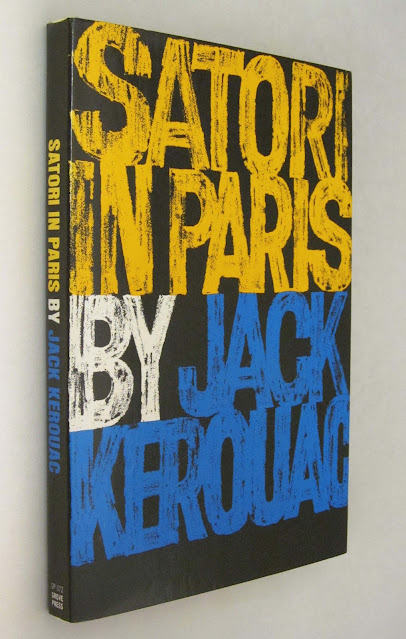
Satori in Paris | Jack Kerouac

Satori in Paris was a short autobiographical book (about a bit over 100 pages) by Jack Kerouac in which he describes as about:


Eileen Campos buys a copy of Kerouac's Satori in Paris